Filters
Question type

Study Flashcards

As long as two people have different opportunity costs, each can gain from trade with the other, since trade allows each person to obtain a good at a price lower than his or her opportunity cost.

A) True
B) False

Correct Answer

verifed

verified

Figure 3-3 Figure 3-3        -Refer to Figure 3-3. If Dina must work 0.25 hour to produce each taco, then her production possibilities frontier is based on how many hours of work? A)  40 hours B)  100 hours C)  400 hours D)  1600 hours Figure 3-3        -Refer to Figure 3-3. If Dina must work 0.25 hour to produce each taco, then her production possibilities frontier is based on how many hours of work? A)  40 hours B)  100 hours C)  400 hours D)  1600 hours Figure 3-3        -Refer to Figure 3-3. If Dina must work 0.25 hour to produce each taco, then her production possibilities frontier is based on how many hours of work? A)  40 hours B)  100 hours C)  400 hours D)  1600 hours -Refer to Figure 3-3. If Dina must work 0.25 hour to produce each taco, then her production possibilities frontier is based on how many hours of work?


A) 40 hours
B) 100 hours
C) 400 hours
D) 1600 hours

E) A) and B)
F) None of the above

Correct Answer

verifed

verified

Figure 3-5 Figure 3-5        -Refer to Figure 3-5. Hosne's opportunity cost of one wallet is A)  4/5 purse and Merve's opportunity cost of one wallet is 2/3 purse. B)  4/5 purse and Merve's opportunity cost of one wallet is 3/2 purses. C)  5/4 purses and Merve's opportunity cost of one wallet is 2/3 purse. D)  5/4 purses and Merve's opportunity cost of one wallet is 3/2 purses. Figure 3-5        -Refer to Figure 3-5. Hosne's opportunity cost of one wallet is A)  4/5 purse and Merve's opportunity cost of one wallet is 2/3 purse. B)  4/5 purse and Merve's opportunity cost of one wallet is 3/2 purses. C)  5/4 purses and Merve's opportunity cost of one wallet is 2/3 purse. D)  5/4 purses and Merve's opportunity cost of one wallet is 3/2 purses. Figure 3-5        -Refer to Figure 3-5. Hosne's opportunity cost of one wallet is A)  4/5 purse and Merve's opportunity cost of one wallet is 2/3 purse. B)  4/5 purse and Merve's opportunity cost of one wallet is 3/2 purses. C)  5/4 purses and Merve's opportunity cost of one wallet is 2/3 purse. D)  5/4 purses and Merve's opportunity cost of one wallet is 3/2 purses. -Refer to Figure 3-5. Hosne's opportunity cost of one wallet is


A) 4/5 purse and Merve's opportunity cost of one wallet is 2/3 purse.
B) 4/5 purse and Merve's opportunity cost of one wallet is 3/2 purses.
C) 5/4 purses and Merve's opportunity cost of one wallet is 2/3 purse.
D) 5/4 purses and Merve's opportunity cost of one wallet is 3/2 purses.

E) A) and B)
F) A) and D)

Correct Answer

verifed

verified

For a country producing two goods, the opportunity cost of one good will be the inverse of the opportunity cost of the other good.

A) True
B) False

Correct Answer

verifed

verified

Table 3-2 Assume that Aruba and Iceland can switch between producing coolers and producing radios at a constant rate. Table 3-2 Assume that Aruba and Iceland can switch between producing coolers and producing radios at a constant rate.    -Refer to Table 3-2. Aruba's opportunity cost of one cooler is A)  0.4 radio and Iceland's opportunity cost of one cooler is 0.25 radio. B)  0.4 radio and Iceland's opportunity cost of one cooler is 4 radios. C)  2.5 radios and Iceland's opportunity cost of one cooler is 0.25 radio. D)  2.5 radios and Iceland's opportunity cost of one cooler is 4 radios. -Refer to Table 3-2. Aruba's opportunity cost of one cooler is


A) 0.4 radio and Iceland's opportunity cost of one cooler is 0.25 radio.
B) 0.4 radio and Iceland's opportunity cost of one cooler is 4 radios.
C) 2.5 radios and Iceland's opportunity cost of one cooler is 0.25 radio.
D) 2.5 radios and Iceland's opportunity cost of one cooler is 4 radios.

E) B) and C)
F) A) and D)

Correct Answer

verifed

verified

Figure 3-7 Figure 3-7        -Refer to Figure 3-7. The opportunity cost of 1 cup for Bintu is A)  1/8 bowl. B)  1/4 bowl. C)  4 bowls. D)  8 bowls. Figure 3-7        -Refer to Figure 3-7. The opportunity cost of 1 cup for Bintu is A)  1/8 bowl. B)  1/4 bowl. C)  4 bowls. D)  8 bowls. Figure 3-7        -Refer to Figure 3-7. The opportunity cost of 1 cup for Bintu is A)  1/8 bowl. B)  1/4 bowl. C)  4 bowls. D)  8 bowls. -Refer to Figure 3-7. The opportunity cost of 1 cup for Bintu is


A) 1/8 bowl.
B) 1/4 bowl.
C) 4 bowls.
D) 8 bowls.

E) C) and D)
F) A) and D)

Correct Answer

verifed

verified

Suppose that a worker in Freedonia can produce either 6 units of corn or 2 units of wheat per year, and a worker in Sylvania can produce either 2 units of corn or 6 units of wheat per year. Each nation has 10 workers. Without trade, Freedonia produces and consumes 30 units of corn and 10 units of wheat per year. Sylvania produces and consumes 10 units of corn and 30 units of wheat. Suppose that trade is then initiated between the two countries, and Freedonia sends 30 units of corn to Sylvania in exchange for 30 units of wheat. Freedonia will now be able to consume a maximum of


A) 30 units of corn and 30 units of wheat.
B) 40 units of corn and 30 units of wheat.
C) 40 units of corn and 20 units of wheat.
D) 10 units of corn and 40 units of wheat.

E) A) and B)
F) A) and C)

Correct Answer

verifed

verified

Figure 3-6 Figure 3-6        -Refer to Figure 3-6. Suppose Maxine decides to increase her production of tarts by 5. What is the opportunity cost of this decision? A)  2/5 pie B)  2 pies C)  5/2 pies D)  10 pies Figure 3-6        -Refer to Figure 3-6. Suppose Maxine decides to increase her production of tarts by 5. What is the opportunity cost of this decision? A)  2/5 pie B)  2 pies C)  5/2 pies D)  10 pies Figure 3-6        -Refer to Figure 3-6. Suppose Maxine decides to increase her production of tarts by 5. What is the opportunity cost of this decision? A)  2/5 pie B)  2 pies C)  5/2 pies D)  10 pies -Refer to Figure 3-6. Suppose Maxine decides to increase her production of tarts by 5. What is the opportunity cost of this decision?


A) 2/5 pie
B) 2 pies
C) 5/2 pies
D) 10 pies

E) None of the above
F) B) and C)

Correct Answer

verifed

verified

Figure 3-4 Figure 3-4        -Refer to Figure 3-4. Perry should specialize in the production of A)  novels. B)  poems. C)  both goods. D)  neither good. Figure 3-4        -Refer to Figure 3-4. Perry should specialize in the production of A)  novels. B)  poems. C)  both goods. D)  neither good. Figure 3-4        -Refer to Figure 3-4. Perry should specialize in the production of A)  novels. B)  poems. C)  both goods. D)  neither good. -Refer to Figure 3-4. Perry should specialize in the production of


A) novels.
B) poems.
C) both goods.
D) neither good.

E) All of the above
F) None of the above

Correct Answer

verifed

verified

Figure 3-8 Figure 3-8        -Refer to Figure 3-8. Chile has a comparative advantage in the production of A)  coffee and Colombia has a comparative advantage in the production of soybeans. B)  soybeans and Colombia has a comparative advantage in the production of coffee. C)  both goods and Colombia has a comparative advantage in the production of neither good. D)  neither good and Colombia has a comparative advantage in the production of both goods. Figure 3-8        -Refer to Figure 3-8. Chile has a comparative advantage in the production of A)  coffee and Colombia has a comparative advantage in the production of soybeans. B)  soybeans and Colombia has a comparative advantage in the production of coffee. C)  both goods and Colombia has a comparative advantage in the production of neither good. D)  neither good and Colombia has a comparative advantage in the production of both goods. Figure 3-8        -Refer to Figure 3-8. Chile has a comparative advantage in the production of A)  coffee and Colombia has a comparative advantage in the production of soybeans. B)  soybeans and Colombia has a comparative advantage in the production of coffee. C)  both goods and Colombia has a comparative advantage in the production of neither good. D)  neither good and Colombia has a comparative advantage in the production of both goods. -Refer to Figure 3-8. Chile has a comparative advantage in the production of


A) coffee and Colombia has a comparative advantage in the production of soybeans.
B) soybeans and Colombia has a comparative advantage in the production of coffee.
C) both goods and Colombia has a comparative advantage in the production of neither good.
D) neither good and Colombia has a comparative advantage in the production of both goods.

E) A) and B)
F) A) and C)

Correct Answer

verifed

verified

Consider two individuals - Howard and Mai - each of whom would like to wear sweaters and eat tasty food. The gains from trade between Howard and Mai are least obvious in which of the following cases?


A) Howard is very good at knitting sweaters and at cooking tasty food, but Mai's skills in both of these activities are very poor.
B) Howard is very good at knitting sweaters and at cooking tasty food; Mai is very good at knitting sweaters, but she knows nothing about cooking tasty food.
C) Howard's skills in knitting sweaters are fairly good, but his skills in cooking tasty food are fairly bad; Mai's skills in knitting sweaters are fairly bad, but her skills in cooking tasty food are fairly good.
D) Howard's skills are such that he can produce only sweaters, and Mai's skills are such that she can produce only tasty food.

E) None of the above
F) C) and D)

Correct Answer

verifed

verified

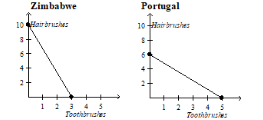
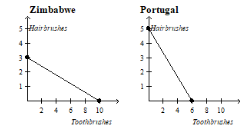
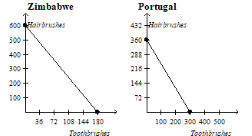
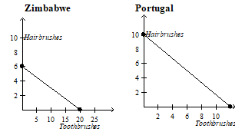
Table 3-3 Assume that Zimbabwe and Portugal can switch between producing toothbrushes and producing hairbrushes at a constant rate. Table 3-3 Assume that Zimbabwe and Portugal can switch between producing toothbrushes and producing hairbrushes at a constant rate.    -Refer to Table 3-3. Which of the following represents Zimbabwe's and Portugal's production possibilities frontiers when each country has 60 minutes of machine time available? A)   B)   C)   D)  -Refer to Table 3-3. Which of the following represents Zimbabwe's and Portugal's production possibilities frontiers when each country has 60 minutes of machine time available?


A) Table 3-3 Assume that Zimbabwe and Portugal can switch between producing toothbrushes and producing hairbrushes at a constant rate.    -Refer to Table 3-3. Which of the following represents Zimbabwe's and Portugal's production possibilities frontiers when each country has 60 minutes of machine time available? A)   B)   C)   D)
B) Table 3-3 Assume that Zimbabwe and Portugal can switch between producing toothbrushes and producing hairbrushes at a constant rate.    -Refer to Table 3-3. Which of the following represents Zimbabwe's and Portugal's production possibilities frontiers when each country has 60 minutes of machine time available? A)   B)   C)   D)
C) Table 3-3 Assume that Zimbabwe and Portugal can switch between producing toothbrushes and producing hairbrushes at a constant rate.    -Refer to Table 3-3. Which of the following represents Zimbabwe's and Portugal's production possibilities frontiers when each country has 60 minutes of machine time available? A)   B)   C)   D)
D) Table 3-3 Assume that Zimbabwe and Portugal can switch between producing toothbrushes and producing hairbrushes at a constant rate.    -Refer to Table 3-3. Which of the following represents Zimbabwe's and Portugal's production possibilities frontiers when each country has 60 minutes of machine time available? A)   B)   C)   D)

E) A) and C)
F) C) and D)

Correct Answer

verifed

verified

Suppose that a worker in Cornland can grow either 40 bushels of corn or 10 bushels of oats per year, and a worker in Oatland can grow either 20 bushels of corn or 5 bushels of oats per year. There are 20 workers in Cornland and 20 workers in Oatland. Which of the following statements is true?


A) Both countries could gain from trade with each other.
B) Neither country could gain from trade with each other because Cornland has an absolute advantage in both goods.
C) Neither country could gain from trade with each other because neither one has a comparative advantage.
D) Oatland could gain from trade between the two countries, but Cornland definitively would lose.

E) A) and C)
F) A) and B)

Correct Answer

verifed

verified

Table 3-6 Assume that Maya and Miguel can switch between producing mixers and producing toasters at a constant rate. Table 3-6 Assume that Maya and Miguel can switch between producing mixers and producing toasters at a constant rate.    -Refer to Table 3-6. We could use the information in the table to draw a production possibilities frontier for Maya and a second production possibilities frontier for Miguel. If we were to do this, measuring mixers along the horizontal axis, then A)  the slope of Maya's production possibilities frontier would be -1.6 and the slope of Miguel's production possibilities frontier would be -2. B)  the slope of Maya's production possibilities frontier would be -0.625 and the slope of Miguel's production possibilities frontier would be -0.5. C)  the slope of Maya's production possibilities frontier would be 0.625 and the slope of Miguel's production possibilities frontier would be 0.5. D)  the slope of Maya's production possibilities frontier would be 1.6 and the slope of Miguel's production possibilities frontier would be 2. -Refer to Table 3-6. We could use the information in the table to draw a production possibilities frontier for Maya and a second production possibilities frontier for Miguel. If we were to do this, measuring mixers along the horizontal axis, then


A) the slope of Maya's production possibilities frontier would be -1.6 and the slope of Miguel's production possibilities frontier would be -2.
B) the slope of Maya's production possibilities frontier would be -0.625 and the slope of Miguel's production possibilities frontier would be -0.5.
C) the slope of Maya's production possibilities frontier would be 0.625 and the slope of Miguel's production possibilities frontier would be 0.5.
D) the slope of Maya's production possibilities frontier would be 1.6 and the slope of Miguel's production possibilities frontier would be 2.

E) A) and C)
F) C) and D)

Correct Answer

verifed

verified

Figure 3-6 Figure 3-6        -Refer to Figure 3-6. If the production possibilities frontiers shown are each for one day of work, then which of the following combinations of pies and tarts could Maxine and Daisy together not make in a given day? A)  2 pies and 25 tarts B)  10 pies and 22 tarts C)  12 pies and 15 tarts D)  15 pies and 16 tarts Figure 3-6        -Refer to Figure 3-6. If the production possibilities frontiers shown are each for one day of work, then which of the following combinations of pies and tarts could Maxine and Daisy together not make in a given day? A)  2 pies and 25 tarts B)  10 pies and 22 tarts C)  12 pies and 15 tarts D)  15 pies and 16 tarts Figure 3-6        -Refer to Figure 3-6. If the production possibilities frontiers shown are each for one day of work, then which of the following combinations of pies and tarts could Maxine and Daisy together not make in a given day? A)  2 pies and 25 tarts B)  10 pies and 22 tarts C)  12 pies and 15 tarts D)  15 pies and 16 tarts -Refer to Figure 3-6. If the production possibilities frontiers shown are each for one day of work, then which of the following combinations of pies and tarts could Maxine and Daisy together not make in a given day?


A) 2 pies and 25 tarts
B) 10 pies and 22 tarts
C) 12 pies and 15 tarts
D) 15 pies and 16 tarts

E) C) and D)
F) A) and D)

Correct Answer

verifed

verified

If a person chooses self-sufficiency, then she can only consume what she produces.

A) True
B) False

Correct Answer

verifed

verified

Trade allows all countries to achieve greater prosperity.

A) True
B) False

Correct Answer

verifed

verified

A production possibilities frontier is a graph that shows the combination of outputs that an economy should produce.

A) True
B) False

Correct Answer

verifed

verified

If one producer is able to produce a good at a lower opportunity cost than some other producer, then the producer with the lower opportunity cost is said to have an absolute advantage in the production of that good.

A) True
B) False

Correct Answer

verifed

verified

Figure 3-9 Figure 3-9        -Refer to Figure 3-9. If the production possibilities frontiers shown are each for two days of production, then which of the following combinations of bolts and nails could Uzbekistan and Azerbaijan together make in a given 2-day production period? A)  12 bolts and 120 nails B)  24 bolts and 96 nails C)  38 bolts and 50 nails D)  44 bolts and 24 nails Figure 3-9        -Refer to Figure 3-9. If the production possibilities frontiers shown are each for two days of production, then which of the following combinations of bolts and nails could Uzbekistan and Azerbaijan together make in a given 2-day production period? A)  12 bolts and 120 nails B)  24 bolts and 96 nails C)  38 bolts and 50 nails D)  44 bolts and 24 nails Figure 3-9        -Refer to Figure 3-9. If the production possibilities frontiers shown are each for two days of production, then which of the following combinations of bolts and nails could Uzbekistan and Azerbaijan together make in a given 2-day production period? A)  12 bolts and 120 nails B)  24 bolts and 96 nails C)  38 bolts and 50 nails D)  44 bolts and 24 nails -Refer to Figure 3-9. If the production possibilities frontiers shown are each for two days of production, then which of the following combinations of bolts and nails could Uzbekistan and Azerbaijan together make in a given 2-day production period?


A) 12 bolts and 120 nails
B) 24 bolts and 96 nails
C) 38 bolts and 50 nails
D) 44 bolts and 24 nails

E) A) and C)
F) A) and D)

Correct Answer

verifed

verified

Showing 121 - 140 of 413

Related Exams

Show Answer