Filters
Question type

Study Flashcards

Alpha particles are identical to


A) protons.
B) helium atoms.
C) hydrogen atoms.
D) helium nuclei.
E) electrons.

F) A) and B)
G) A) and C)

Correct Answer

verifed

verified

Uranium-235 decays by alpha emission.What isotope is also produced by this transformation?


A) Pa-234
B) Th-237
C) Pu-237
D) Th-231
E) Pu-239

F) D) and E)
G) C) and D)

Correct Answer

verifed

verified

Identify the missing species in the following nuclear transmutation. Identify the missing species in the following nuclear transmutation.   A)    B)    C)    D)    E)


A) Identify the missing species in the following nuclear transmutation.   A)    B)    C)    D)    E)
B) Identify the missing species in the following nuclear transmutation.   A)    B)    C)    D)    E)
C) Identify the missing species in the following nuclear transmutation.   A)    B)    C)    D)    E)
D) Identify the missing species in the following nuclear transmutation.   A)    B)    C)    D)    E)
E) Identify the missing species in the following nuclear transmutation.   A)    B)    C)    D)    E)

F) C) and D)
G) C) and E)

Correct Answer

verifed

verified

The dose unit of ionizing radiation is called the rad.The rad is defined in terms of


A) the half-life of a radioisotope.
B) the energy deposited per gram of an object.
C) the biological damage produced.
D) the accumulation of fission products.
E) the number of ions per centimeter.

F) A) and B)
G) C) and D)

Correct Answer

verifed

verified

B

1 joule equals _____.


A) 1 kg • m
B) 1 g • m2 • s2
C) 1 kg • m2/s
D) 1 g • m2/s
E) 1 kg • m2/s2

F) B) and D)
G) C) and D)

Correct Answer

verifed

verified

A particle accelerator uses which of the following to increase the kinetic energy of charged species so that a reaction will occur?


A) Electromagnetic fields
B) Fission reaction
C) Gravitational field
D) Fusion reaction
E) Combustion reaction

F) B) and C)
G) A) and C)

Correct Answer

verifed

verified

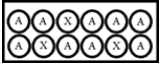
In the following diagrams,A represents a radioactive isotope that decays into a new isotope,X.Each circle represents 1 mmol of atoms. t = 0: In the following diagrams,A represents a radioactive isotope that decays into a new isotope,X.Each circle represents 1 mmol of atoms. t = 0:   t = 25.0 s:   Over the first 25.0 s,what is the disintegration rate of A? A) 0.120 disintegrations per second B) 1.81 × 10<sup>21</sup> disintegrations per second C) 3.00 disintegrations per second D) 7.23 × 10<sup>19</sup> disintegrations per second E) 1.38 × 10<sup>-2</sup><sup>0</sup> disintegrations per second t = 25.0 s: In the following diagrams,A represents a radioactive isotope that decays into a new isotope,X.Each circle represents 1 mmol of atoms. t = 0:   t = 25.0 s:   Over the first 25.0 s,what is the disintegration rate of A? A) 0.120 disintegrations per second B) 1.81 × 10<sup>21</sup> disintegrations per second C) 3.00 disintegrations per second D) 7.23 × 10<sup>19</sup> disintegrations per second E) 1.38 × 10<sup>-2</sup><sup>0</sup> disintegrations per second Over the first 25.0 s,what is the disintegration rate of A?


A) 0.120 disintegrations per second
B) 1.81 × 10²¹ disintegrations per second
C) 3.00 disintegrations per second
D) 7.23 × 10¹⁹ disintegrations per second
E) 1.38 × 10⁻²⁰ disintegrations per second

F) D) and E)
G) A) and B)

Correct Answer

verifed

verified

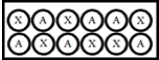
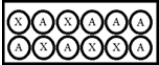
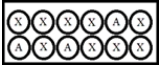
In the following diagrams,A represents a radioactive isotope that decays into a new isotope,X.Each circle represents 1 mmol of atoms. t = 0: In the following diagrams,A represents a radioactive isotope that decays into a new isotope,X.Each circle represents 1 mmol of atoms. t = 0:   t = 25.0 s:   Which diagram best represents the sample at t = 50.0 s? A)    B)    C)    D)    E)   t = 25.0 s: In the following diagrams,A represents a radioactive isotope that decays into a new isotope,X.Each circle represents 1 mmol of atoms. t = 0:   t = 25.0 s:   Which diagram best represents the sample at t = 50.0 s? A)    B)    C)    D)    E)   Which diagram best represents the sample at t = 50.0 s?


A) In the following diagrams,A represents a radioactive isotope that decays into a new isotope,X.Each circle represents 1 mmol of atoms. t = 0:   t = 25.0 s:   Which diagram best represents the sample at t = 50.0 s? A)    B)    C)    D)    E)
B) In the following diagrams,A represents a radioactive isotope that decays into a new isotope,X.Each circle represents 1 mmol of atoms. t = 0:   t = 25.0 s:   Which diagram best represents the sample at t = 50.0 s? A)    B)    C)    D)    E)
C) In the following diagrams,A represents a radioactive isotope that decays into a new isotope,X.Each circle represents 1 mmol of atoms. t = 0:   t = 25.0 s:   Which diagram best represents the sample at t = 50.0 s? A)    B)    C)    D)    E)
D) In the following diagrams,A represents a radioactive isotope that decays into a new isotope,X.Each circle represents 1 mmol of atoms. t = 0:   t = 25.0 s:   Which diagram best represents the sample at t = 50.0 s? A)    B)    C)    D)    E)
E) In the following diagrams,A represents a radioactive isotope that decays into a new isotope,X.Each circle represents 1 mmol of atoms. t = 0:   t = 25.0 s:   Which diagram best represents the sample at t = 50.0 s? A)    B)    C)    D)    E)

F) A) and C)
G) A) and E)

Correct Answer

verifed

verified

For stable atoms of elements having low atomic numbers (≤ 20),the neutron-to-proton ratio is close to zero.

A) True
B) False

Correct Answer

verifed

verified

False

Which isotope,when bombarded with nitrogen-15,yields four neutrons and the artificial isotope dubnium-260?


A) Californium-245
B) Thorium-257
C) Nobelium-245
D) Californium-249
E) Dubnium-249

F) B) and D)
G) None of the above

Correct Answer

verifed

verified

Calculate the energy released in joules when one mole of polonium-214 decays according to the following equation. Calculate the energy released in joules when one mole of polonium-214 decays according to the following equation.   Particle Mass (amu)  Pb-210 209) 98284 Po-214 213) 99519 He-4 4) 00260 (1 kg = 6.022 × 10<sup>26</sup> amu; N<sub>A</sub> = 6.022 × 10<sup>23</sup> mol<sup>-1</sup>; C = 2.99792458 × 10<sup>8</sup> m/s)  A) 8.78 × 10<sup>14</sup> J/mol B) 7.2 × 10<sup>14</sup> J/mol C) 8.76 × 10<sup>11</sup> J/mol D) -9.75 × 10<sup>-3</sup> J/mol E) 1.46 × 10<sup>-9</sup> J/mol Particle Mass (amu) Pb-210 209) 98284 Po-214 213) 99519 He-4 4) 00260 (1 kg = 6.022 × 1026 amu; NA = 6.022 × 10²³ mol-1; C = 2.99792458 × 10⁸ m/s)


A) 8.78 × 10¹⁴ J/mol
B) 7.2 × 10¹⁴ J/mol
C) 8.76 × 10¹¹ J/mol
D) -9.75 × 10⁻³ J/mol
E) 1.46 × 10⁻⁹ J/mol

F) B) and E)
G) B) and D)

Correct Answer

verifed

verified

Why is carbon dating possible?


A) The amount of C-12 is not variable in living organisms.
B) There is a constant ratio of C-12 to C-14 in living organisms but the ratio changes at a predictable rate after an organism dies.
C) The amount of C-14 is constant in living organisms.
D) None of the.

E) B) and C)
F) C) and D)

Correct Answer

verifed

verified

A 55-kg person exposed to thorium-234 receives 7.5 × 10⁴ β particles,each with an energy of 1.6 × 10⁻¹⁴ J.How many rads does the person receive?


A) 2.1 × 10⁻¹⁹ rads
B) 1.2 × 10⁻¹⁷ rads
C) 2.2 × 10⁻⁹ rads
D) 1.2 × 10⁻⁹ rads
E) None of these choices is correct.

F) None of the above
G) C) and E)

Correct Answer

verifed

verified

A gamma particle has a charge of -1.

A) True
B) False

Correct Answer

verifed

verified

What fraction of radioactive atoms remains in a sample after six half-lives?


A) zero
B) 1/6
C) 1/16
D) 1/32
E) 1/64

F) All of the above
G) D) and E)

Correct Answer

verifed

verified

Which is an incorrect representation of the indicated particle or nucleus?


A) Which is an incorrect representation of the indicated particle or nucleus? A)    B)    C)    D)    E)
B) Which is an incorrect representation of the indicated particle or nucleus? A)    B)    C)    D)    E)
C) Which is an incorrect representation of the indicated particle or nucleus? A)    B)    C)    D)    E)
D) Which is an incorrect representation of the indicated particle or nucleus? A)    B)    C)    D)    E)
E) Which is an incorrect representation of the indicated particle or nucleus? A)    B)    C)    D)    E)

F) A) and B)
G) All of the above

Correct Answer

verifed

verified

The ___________ _________ ___________ is a quantitative measure of the nuclear stability of a nucleus,which is the energy required to break up a nucleus into its component protons and neutrons.

Correct Answer

verifed

verified

nuclear bi...

View Answer

Nuclei with an _____ number of protons and an _____ number of neutrons tend to be more stable than those with an _____ number of protons and/or an _____ number of neutrons.


A) even; odd; odd; even
B) even; even; odd; odd
C) odd; odd; even; even
D) odd; even; even; odd
E) odd; odd; even; odd

F) C) and E)
G) B) and E)

Correct Answer

verifed

verified

Select the nuclide that completes the following nuclear reaction Select the nuclide that completes the following nuclear reaction   ? A)    B)    C)    D)    E) None of these choices is correct. ?


A) Select the nuclide that completes the following nuclear reaction   ? A)    B)    C)    D)    E) None of these choices is correct.
B) Select the nuclide that completes the following nuclear reaction   ? A)    B)    C)    D)    E) None of these choices is correct.
C) Select the nuclide that completes the following nuclear reaction   ? A)    B)    C)    D)    E) None of these choices is correct.
D) Select the nuclide that completes the following nuclear reaction   ? A)    B)    C)    D)    E) None of these choices is correct.
E) None of these choices is correct.

F) C) and D)
G) C) and E)

Correct Answer

verifed

verified

Identify the missing species in the following nuclear transmutation. U-238 + ? → 1 neutron + Fm-249


A) Identify the missing species in the following nuclear transmutation. U-238 + ? → 1 neutron + Fm-249 A)    B)    C)    D)    E)
B) Identify the missing species in the following nuclear transmutation. U-238 + ? → 1 neutron + Fm-249 A)    B)    C)    D)    E)
C) Identify the missing species in the following nuclear transmutation. U-238 + ? → 1 neutron + Fm-249 A)    B)    C)    D)    E)
D) Identify the missing species in the following nuclear transmutation. U-238 + ? → 1 neutron + Fm-249 A)    B)    C)    D)    E)
E) Identify the missing species in the following nuclear transmutation. U-238 + ? → 1 neutron + Fm-249 A)    B)    C)    D)    E)

F) A) and D)
G) A) and C)

Correct Answer

verifed

verified

D

Showing 1 - 20 of 125

Related Exams

Show Answer